The building and the way in
Palazzo dei Mutilati Verona: the venue
The Palazzo dei Mutilati in Verona explained: why it was built, who designed it, what the Sala Girelli is, where the door is and how check-in works.
Reserve a seat in the palace ↗Quick answer
The Palazzo dei Mutilati, also called the Casa del Mutilato, stands on via dei Mutilati just outside the Portoni della Bra. It was built for Verona's war-disabled veterans' association, designed by Francesco Banterle and inaugurated on 16 September 1934. The concert is held in its meeting hall, the Sala Antonio Girelli. You enter by the big door at the top of the steps, and wheelchair users use a side entrance. At check-in you fill in a membership card.
Where the palace is
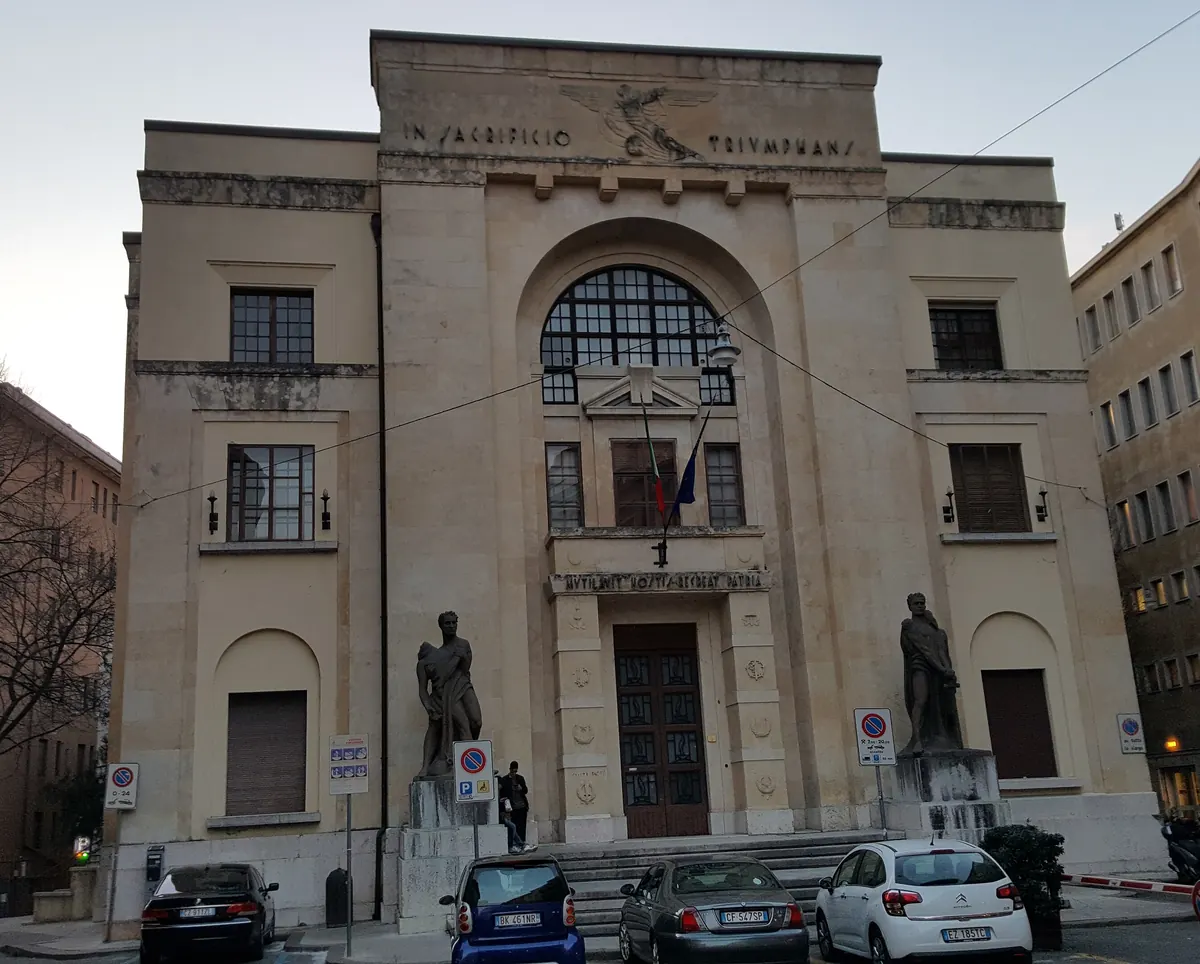
The palace is on via dei Mutilati, a street just outside the Portoni della Bra, the old city-wall gate beside Corso Porta Nuova, on the edge of the historic centre. The street itself was laid out in the 1930s. Before then a waterway called the Adigetto ran here, a moat that protected the city and had stayed in use into the Middle Ages, and it was covered over as Verona expanded. The map pin on the ticket marks the meeting point. In Italian the building is also called the Casa del Mutilato, the house of the war-disabled, which explains the name. Italian Wikipedia puts it a few steps from the Portoni della Bra and Corso Porta Nuova.
Finding the door
Take the steps and enter by the big door at the top. Wheelchair users enter from the side of the building, and the ticket is marked wheelchair accessible. The meeting point is in your confirmation, so check it before you leave and do not rely on a sign. Inside, the atrium leads straight to the hall. Leave a few minutes at the door for check-in, because the ticket asks you to complete a membership card with your first and last name and your country of residence. That is the cultural association's routine, and it applies to every guest.
Why the palace exists
The Verona section of the Associazione Nazionale fra Mutilati e Invalidi di Guerra, the national association of war-disabled veterans, raised the money for its own headquarters at the start of the 1930s. Public bodies, private bodies, ordinary citizens and the veterans themselves gave. The first stone was laid in May 1933, the work went fast, and the building was inaugurated on 16 September 1934. It was a veterans' house first, with offices, an archive, a surgery and meeting rooms, and a hall large enough for assemblies. The concert uses a room the association already had.
The Banterle brothers
Francesco Banterle designed the palace, working with his brother Ruperto, a sculptor. The front recalls a triumphal arch: a large arched opening above the door, a winged Victory in relief on the top storey, and Latin inscriptions on the stone. Two statues by Ruperto Banterle stand beside the entrance, and they are described as showing a dying soldier's sacrifice, the fellowship of the comrade who supports him, and the memory of what was lived as a warning, with peace as the only worthy weapon between peoples. The arch, the inscriptions and the sculpture all belong to the palace's purpose as a place of commemoration for the war-disabled.
Read next: A Verona evening around the concert
The atrium and the stairs
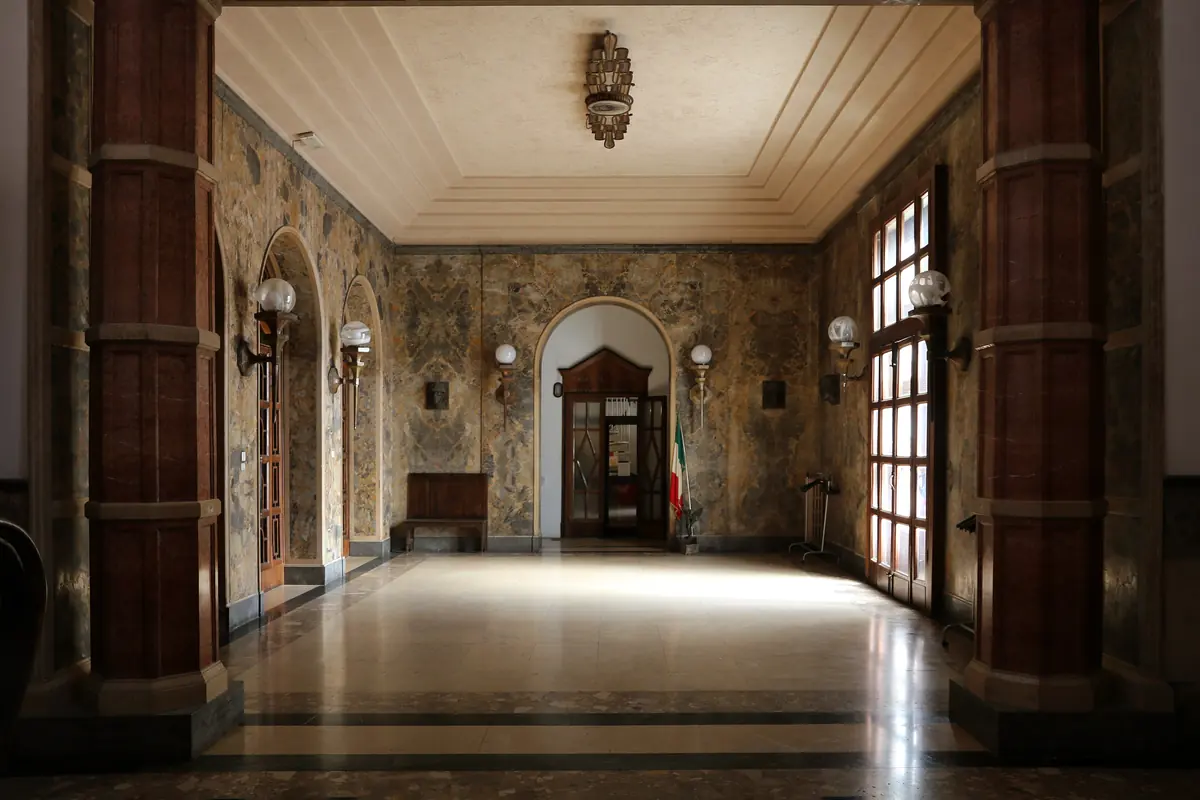
The first room is a wide marble atrium. It carries four heads of fighters, also by Banterle, and a chandelier whose shapes recall bundles of bayonets and flames. Two large columns of deep red Sant'Ambrogio marble lead on to the stair hall, which is faced in brightly coloured marble and has a handrail on slim chromed posts. A ceiling fresco by Orazio Pigato, showing Fascism supporting a war-disabled man guided to Victory, once decorated it but has been lost. These are the rooms you pass through, and the ticket includes access to them, so arrive a little early to look around. Upstairs are the association's offices, archive and meeting rooms, each dedicated to the mother of a distinguished war-disabled man.
The Sala Antonio Girelli
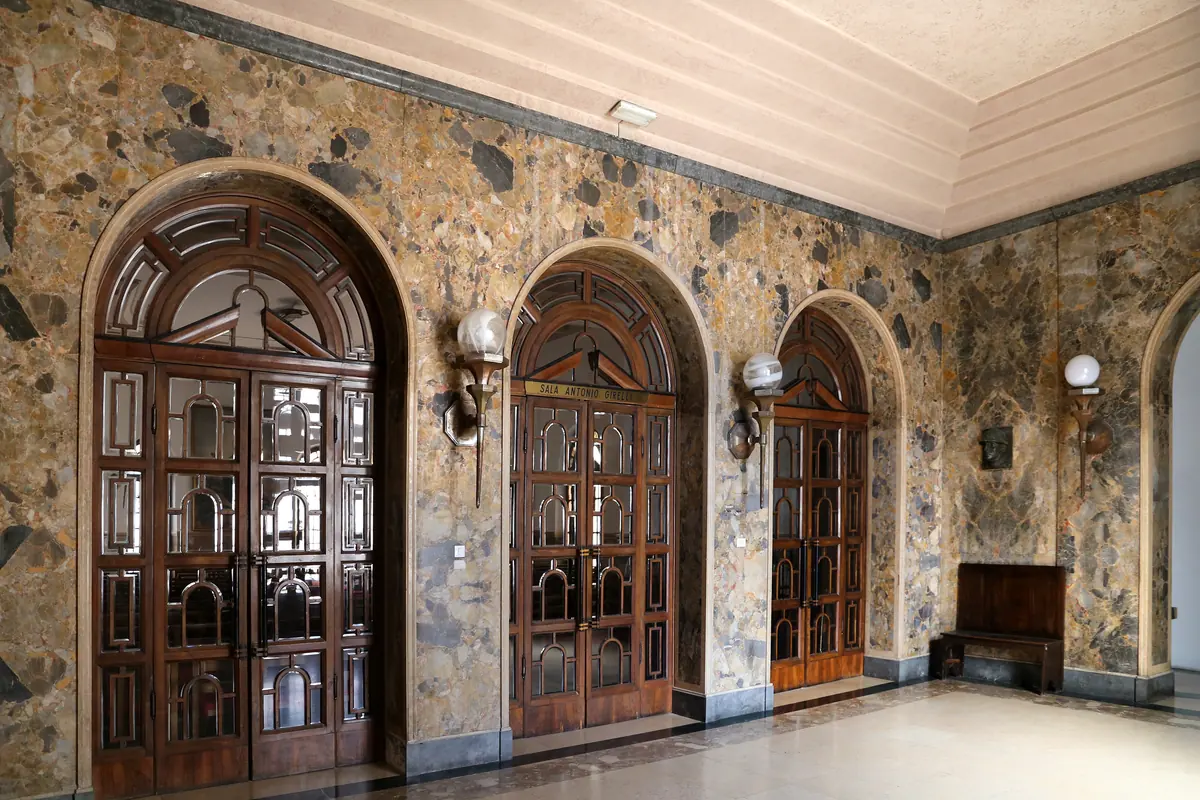
Facing the entrance, a door from the atrium opens into the Salone delle Adunanze, the assembly hall, which is named for Antonio Girelli. He was a professor who helped promote the building and led the Verona section of the association until 1967. The hall ends in a semicircular apse, where the speakers' table stands, and six windows open along its curved wall, made of finely worked wood with alabaster on the inside and glass outside. Rows of wooden chairs face the apse. This is the room where the concert is held.
Reused and preserved
Near the end of the Second World War the American command in Verona requisitioned the building as its headquarters. After the war Girelli asked local artists, through the newspaper L'Arena, to donate works for the offices, and several painters did, so paintings still hang inside. The only substantial change came in 1956, when the broad semicircular terrace above the hall was built over. The interior is in excellent condition, and most of its original 1934 furniture, also drawn by Banterle, survives. The Foundation of the war-disabled association still occupies part of the palace today, so the hall is a working room, not a theatre.
Names you will see
Three names point to the same building. Concert tickets and this site say Palazzo dei Mutilati. Italian Wikipedia says Casa del Mutilato, the house of the war-disabled. The hall inside is the Sala Antonio Girelli, and the Italian name for the same room is the Salone delle Adunanze, the assembly hall. The street is via dei Mutilati. If you are searching a map or asking for directions, any of these will do, and the association that owns the building is known by the initials ANMIG.
Practicalities on the day
Seats are reserved and assigned on arrival, and a few guests would like more comfortable chairs. The performers meet guests in the atrium afterwards for photographs, so hold your phone back until then and keep the hall clear for the music. Your date's start time is in the calendar and the meeting point is in the confirmation. The ticket names no dress code, so dress for the weather and for a hall with stone floors and tall windows. Arrive a little before the start, with your details ready for the membership card.
A building with a purpose
It helps to remember what the palace is. The concerts happen in a veterans' headquarters built to house a war-disabled community, and the sculpture and inscriptions on the front belong to that purpose. Nobody asks guests to treat the evening as a memorial. But the hall is a working room of the association that built it. Come as a listener, and the building will be what it is: a well-kept public room of the 1930s, with its original furniture, a marble atrium and a front that remembers a generation of soldiers.
Who this isn't for
Neither this guide nor the ticket suits anyone looking for a museum of the war-disabled: the palace is a venue for a concert, and the interiors are a short bonus before and after it. They are also not for travellers who need a large, step-free auditorium with several entrances. There is a side entrance for wheelchair users, but the hall is a plain meeting room, not a theatre with lifts and boxes. If you want an opera house, the Teatro Filarmonico is the city's, and its season is on its own site.
Read next: Verona opera concert: how to book
Frequently asked questions
Is the Palazzo dei Mutilati the same as the Casa del Mutilato?
Yes. Casa del Mutilato is the building's Italian name, meaning the house of the war-disabled. Concert tickets use the name Palazzo dei Mutilati. Both names refer to the palace on via dei Mutilati.
Where exactly is the palace?
On via dei Mutilati, just outside the Portoni della Bra, the city-wall gate by Corso Porta Nuova, on the edge of Verona's historic centre. Your confirmation and the map pin on the ticket show the meeting point.
Can wheelchair users attend?
The ticket is marked wheelchair accessible, and wheelchair users enter from the side of the building rather than by the front steps. Confirm access needs with the booking page before you travel.
Who designed the building?
Francesco Banterle designed it, with his brother Ruperto, a sculptor, who made its statues. The first stone was laid in May 1933 and it was inaugurated on 16 September 1934.
What is the Sala Antonio Girelli?
The palace's assembly hall, named for Antonio Girelli, a promoter of the building who led the Verona section of the association until 1967. It ends in a curved apse with six windows.
Sources